

Expression and substrate targeting of the SPI-1 injectisome

Salmonella injects effector proteins into host cells through the injectisome, a virulence-associated type-III secretion system (vT3SS). We study which cells express it and how its substrates reach the export apparatus.

Assembly of the SPI-1 injectisome and injection of effector proteins, modelled from experimental and predicted structures (67 s, with labels).
Fig. 1 of Saleh et al. 2023, PLOS Pathogens
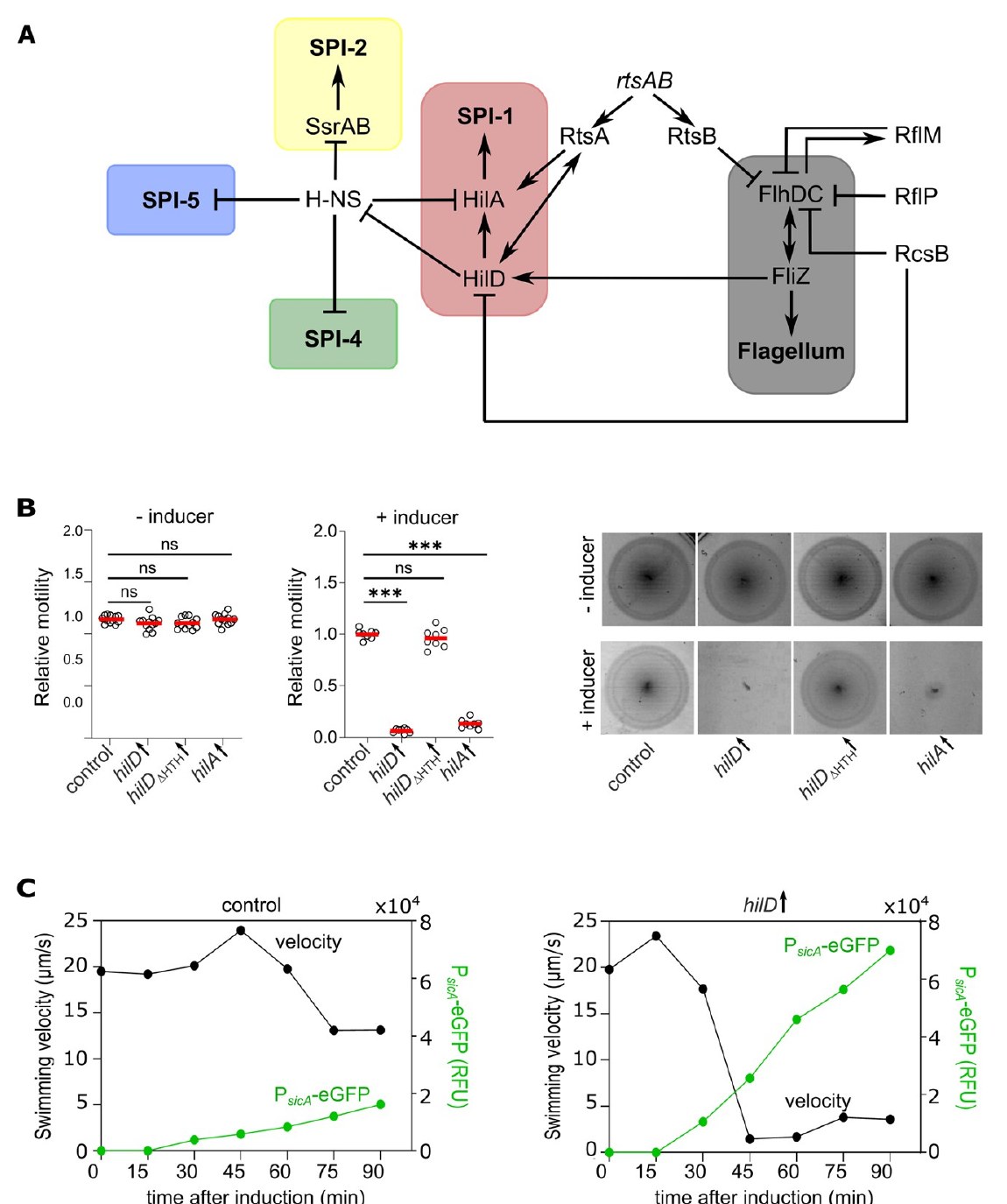
Key figure Induction of HilD stops swimming of Salmonella Typhimurium. A, regulatory cross-talk; B, swimming on soft agar; C, swimming speed and SPI-1 reporter after induction. Fig. 1 of Saleh et al. 2023, PLOS Pathogens, CC BY 4.0, cropped.

During the initial phase of infection, Salmonella Typhimurium uses flagella to reach the intestinal epithelium. It then uses the vT3SS encoded on Salmonella pathogenicity island 1 (SPI-1) to inject effector proteins that mediate bacterial uptake. Only a subset of cells expresses flagella or the injectisome.

Findings

HilD activates the flagellar master operon flhDC

HilD is the master regulator of SPI-1. We showed that HilD directly activates transcription of flhDC. Expression of the injectisome and of flagella is therefore coupled at the level of the master regulators.

Singer et al. 2014, Journal of Bacteriology

SPI-1 expression reduces motility

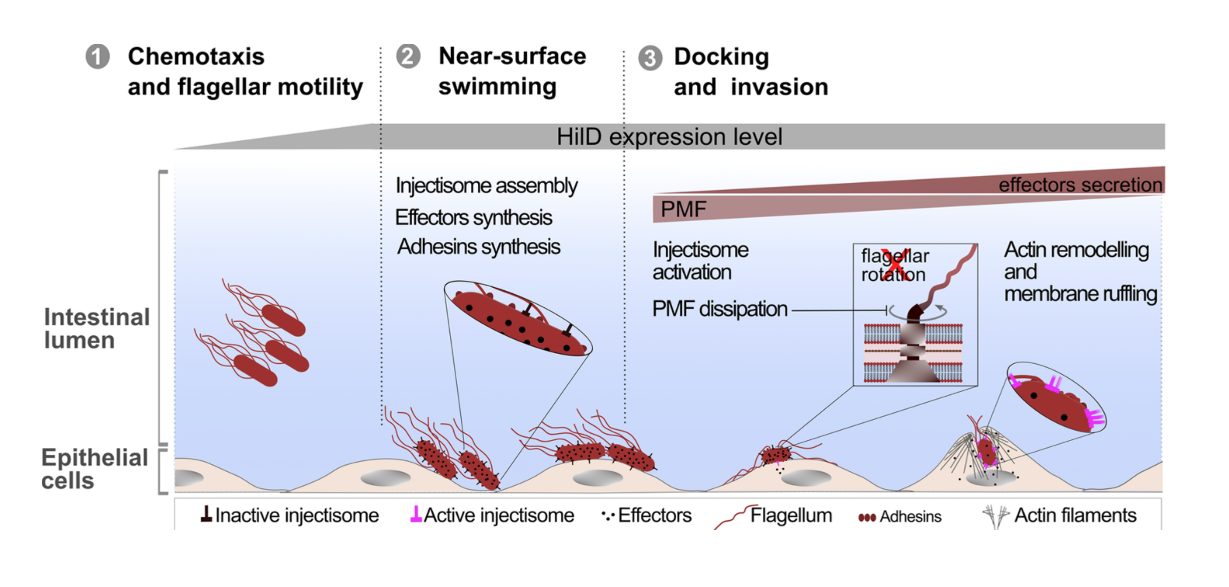
Together with the Klotzsch and Strowig groups, we found that induction of HilD reduced the motility of Salmonella, although HilD activates flhDC. The loss of motility required SPI-1 and depended on the proton motive force and on adhesins.

Saleh et al. 2023, PLOS Pathogens

Model figure
Model of the cross-talk between SPI-1 and motility (Saleh et al. 2023).

Current projects

Single-cell dynamics of virulence gene expression

Expression of flagella and of SPI-1 is heterogeneous. We use dual fluorescent reporter strains in mother-machine devices to follow both programmes in single cells. We compare the wild type and regulatory mutants under different environmental conditions.

Contact: Hannah Raasch, E-mail

Substrate targeting to the injectisome

It is unknown how vT3SS substrates are selected from the cytoplasmic protein pool. We test the hypothesis that substrates are transcribed and translated close to the export apparatus. We combine genetic engineering with epifluorescence, TIRF, iSIM and STED microscopy and transcript localisation assays.

Contact: Hannah Grabietz, E-mail

Selected publications

Next topic: Costs and benefits of motility during infection