
Assembly, protein export and rotation of the bacterial flagellum

The flagellum is a rotary motor with a filament several times longer than the cell. Most of its subunits are exported by a type-III secretion system and assemble outside the cytoplasm.

Flagellum assembly, modelled from cryo-EM and AlphaFold structures (2 min 1 s, with labels).
Fig. 1 of Einenkel, Qin et al. 2025, Nature Microbiology
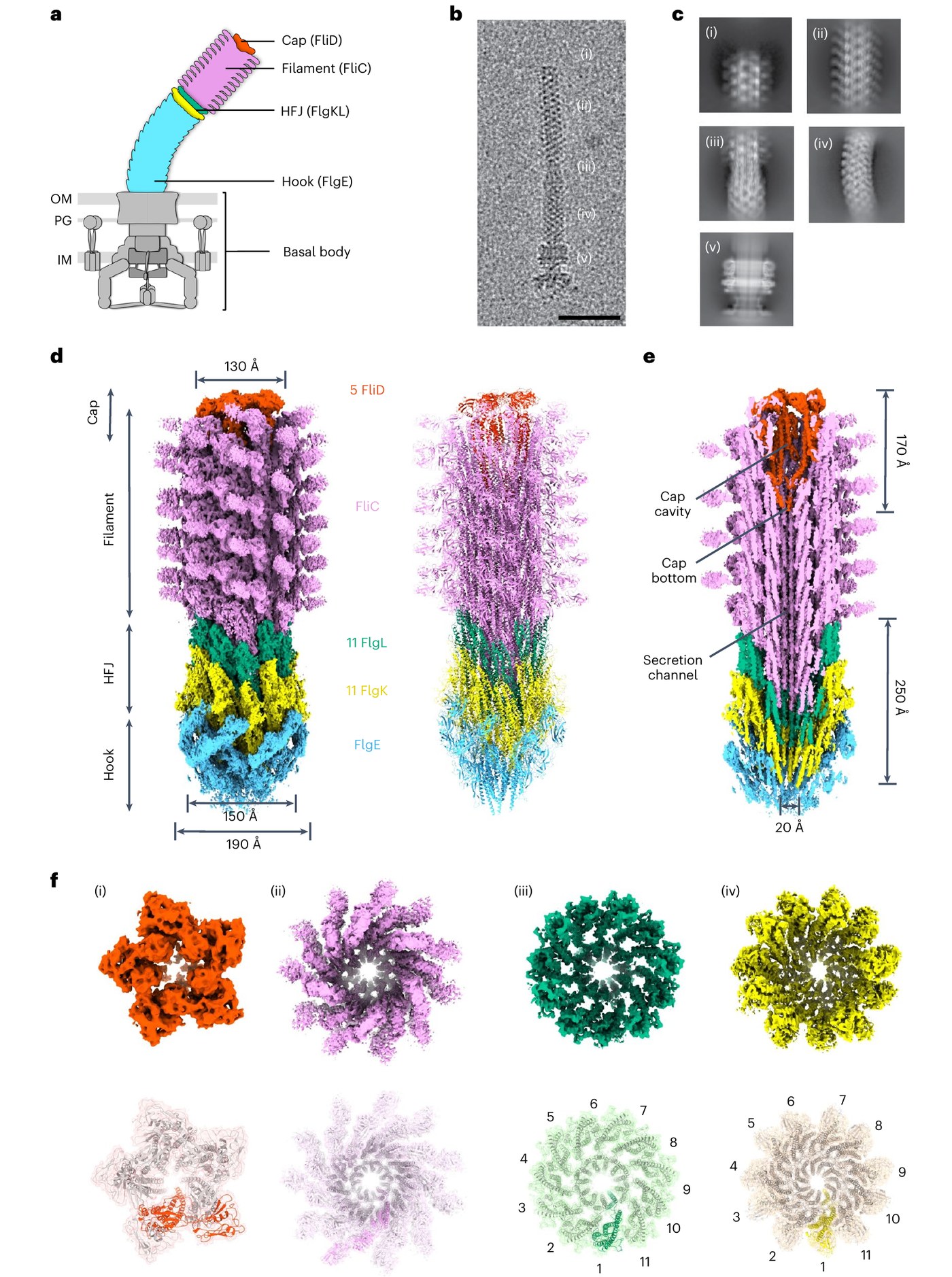
Key figure The complete extracellular flagellum of Salmonella, resolved by cryo-EM from the hook to the FliD cap: cap, filament, hook-filament junction and hook. Fig. 1 of Einenkel, Qin et al. 2025, Nature Microbiology, CC BY 4.0, cropped.

Flagella enable bacteria to swim towards nutrients and away from harmful substances. Many pathogens, including Salmonella enterica, require motility to reach and colonise the host. The filament consists of several thousand flagellin subunits. Each subunit is exported in an unfolded state by the flagellar type-III secretion system (fT3SS), travels through the 2 nm channel of the growing structure and folds at the tip.

Findings

100 nm/mininitial elongation rate

Filaments grow by an injection-diffusion mechanism

We labelled successive filament fragments with maleimide dyes and measured filament growth in single cells. The elongation rate decreased with filament length, from about 100 nm/min initially to about 20 nm/min. A model in which the proton motive force injects subunits into the channel and the subunits then diffuse to the tip describes these kinetics.

Renault et al. 2017, eLife

Injection-diffusion model of filament growth (28 s).

2.5 µmminimal filament length

Swimming requires a filament length of about 2.5 µm

We synchronised flagellar assembly in Salmonella and related filament length to swimming speed. Cells with filaments shorter than about 2.5 µm did not swim. Biophysical modelling attributes this threshold to an elasto-hydrodynamic instability of the swimming cell.

Halte et al. 2025, PNAS

Swimming speed as a function of filament length (25 s).

10,000 aa/smaximal secretion rate

Flagellin is secreted at up to 10,000 amino acids per second

Stepwise filament labelling combined with electron microscopy confirmed flagellin secretion rates of up to 10,000 amino acids per second. In a model of filament growth, this rate balances the elongation rate against the energy cost per subunit. A higher injection rate would shorten the time to motility only slightly.

Halte et al. 2025, PNAS

From proton motive force to swimming, and the associated energy cost (18 s).

3.7 Åresolution of the FliD cap

The FliD cap rotates to incorporate flagellin

Together with the Bergeron group, we determined cryo-EM structures of the complete extracellular flagellum, including the FliD cap at 3.7 Å and the hook-filament junction at 2.9 Å. The structures and structure-guided mutagenesis show that movement of the FliD terminal domains and rotation of the cap allow each flagellin subunit to fold into the filament.

Einenkel et al. 2025, Nat Microbiol

Top view of the density map of the FliD cap on the filament; merged reconstruction from several 3D classes.

5:2MotA:MotB stoichiometry

The stator unit is a rotary motor

Together with the Taylor group, we showed that the stator unit consists of a MotA pentamer around a MotB dimer. Structures in different functional states support a model in which proton flux drives rotation of MotA around MotB. MotA in turn rotates the rotor of the flagellum.

Santiveri et al. 2020, Cell

The stator unit MotA5B2 (16 s).

FlhE prevents the assembly of periplasmic flagella

Salmonella mutants that lack the periplasmic protein FlhE assembled flagella in the periplasm. These flagella disrupted cell-wall synthesis and caused cell lysis. We conclude that FlhE acts as a chaperone during rod assembly.

Halte et al. 2024, Nat Commun

Rod assembly in the wild type and in a ΔflhE mutant. The role of FlhE at the rod cap is a proposed model (39 s).

FliI ATPase activity is required for timely substrate switching

We analysed Salmonella strains with mutations in the catalytic domain of the export ATPase FliI. Minimal ATPase activity was sufficient for early substrate export and hook-basal-body assembly. Efficient substrate-specificity switching and export of late substrates required near-wild-type activity.

Einenkel et al. 2025, mBio

Current projects

Mechanisms of flagellar regulation, assembly and function

We investigate the regulation of the flagellar genes and the heterogeneity of flagellation in single cells, the type-III export apparatus, the filament cap and the recruitment of stator units. We measure the unfolding energy that the fT3SS applies during early and late secretion, and the kinetics of hook assembly. We also compare external and periplasmic flagella.

Contact: Marc Erhardt, E-mail

Engineering of the flagellar secretion system for protein production

ANR-DFG project BacCellFactory

The fT3SS secretes proteins into the culture medium at a high rate. Together with the Université de Bordeaux, we determine which factors limit the secretion of recombinant proteins. We engineer strains for the production of peptides and proteins for diagnostics and biomedicine.

Contact: Min Meijer, E-mail

Methods

Who to ask

  • Marc Erhardt
    Principal investigator · E-mail
  • Kristin Funke
    PhD student · E-mail
  • Dr. Murat Tugrul
    Postdoc · E-mail
  • Min Meijer
    PhD student · E-mail

Selected publications

Next topic: 5:2 rotary motors in motility and anti-phage defence