
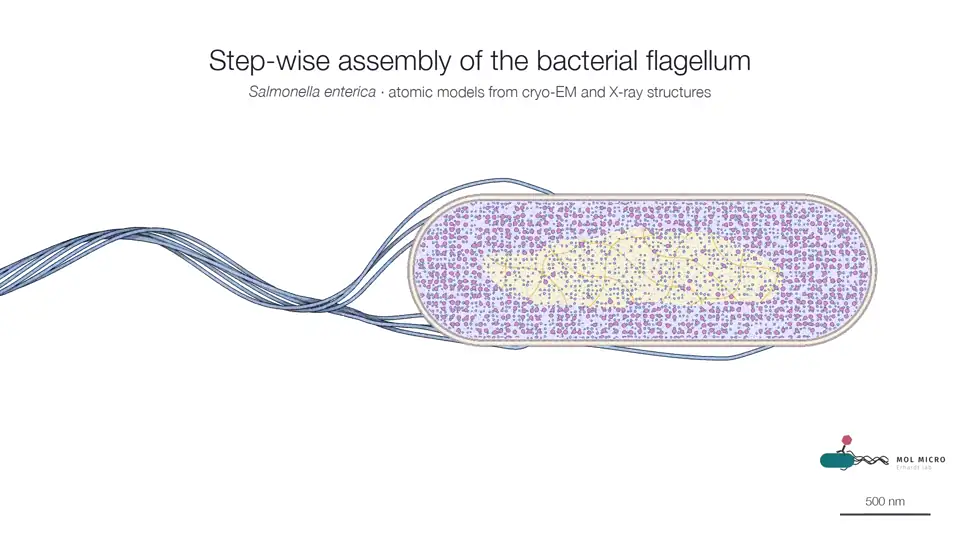
One cell, several flagella
Salmonella enterica carries several flagella. Each one is a rotary motor with a filament several times longer than the cell. The movie builds one flagellum from the inside out, in the order of the flagellar gene hierarchy.
Export gate and MS ring
FlhA, FlhB, FliP, FliQ and FliR form the export gate in the inner membrane. FliF assembles the MS ring around the gate. The class II genes encode these and the other proteins of the hook-basal body.
C ring and export ATPase
FliG, FliM and FliN form the C ring on the cytoplasmic face of the MS ring. The ATPase complex of FliI, FliH and FliJ docks underneath. The cut-away shows the 2 nm channel through which every later subunit travels in an unfolded state.
Rod, P ring and L ring
The rod proteins FlgB, FlgC, FlgF and FlgG are exported through the gate and polymerise across the periplasm. FlgI forms the P ring in the peptidoglycan layer and FlgH the L ring in the outer membrane. FlhE keeps the rod cap in place until the rings have formed (Halte et al. 2024).
The hook and the FliK ruler
FlgE polymerises under the FlgD cap into the hook. The ruler protein FliK is exported from time to time. In a short hook, FliK leaves the channel before its C-terminal domain reaches FlhB. At about 55 nm the C-terminus reaches FlhB while the N-terminus is still in the channel (Erhardt et al. 2011).
The switch and the anti-sigma factor FlgM
FlhB changes substrate specificity. The export apparatus now exports late substrates, among them the anti-sigma factor FlgM. Once FlgM leaves the cell, σ28 is free and the class III genes are transcribed: flagellin, motor and chemotaxis proteins.
Junction, cap and stator units
FlgK and FlgL form the hook-filament junction and FliD the cap. MotA5B2 stator units assemble in the inner membrane and engage the C ring. The stator unit is itself a rotary motor (Santiveri et al. 2020).
Filament growth
Flagellin travels unfolded through the channel and folds under the FliD cap, which rotates to insert each subunit (Einenkel, Qin et al. 2025). The filament grows at about 100 nm/min at first and slows with length, because diffusion in the channel becomes limiting (Renault et al. 2017). After about 2.5 µm the cell can swim (Halte et al. 2025).
Rotation and switching
Proton flux through the stator units turns the rotor counter-clockwise. When CheY-P binds the C ring, the ring changes conformation and the rotor turns clockwise, although the stator units keep their sense of rotation.
Runs and tumbles
Counter-clockwise rotation bundles the filaments and the cell runs. A clockwise interval splays the bundle and the cell tumbles. Alternating runs and tumbles let the cell swim towards nutrients and away from harmful substances.